Ordering Power: Tocqueville on the American Constitution
Essay 3 in Reading Tocqueville at 250

Reminder: I am using multiple translations; my main reading is from the hardbound copy of the Mansfield translation. When I refer to page numbers it’s to the Mansfield translation, and when I want to pull quotes that are longer I’ll use the online Schleifer translation, so the text may not match exactly but they are close (and I also read French so I calibrated across the translations to get comfy with Tocqueville’s word choice).
Note: In this article I use the word institution to signify various branches of government as well as different levels of government in our federal architecture. In this usage institution has more of an organization definition. This usage differs from the usual way I and other economists and political scientists use institution to signify the formal and informal rules by which we structure our interactions and incentives.
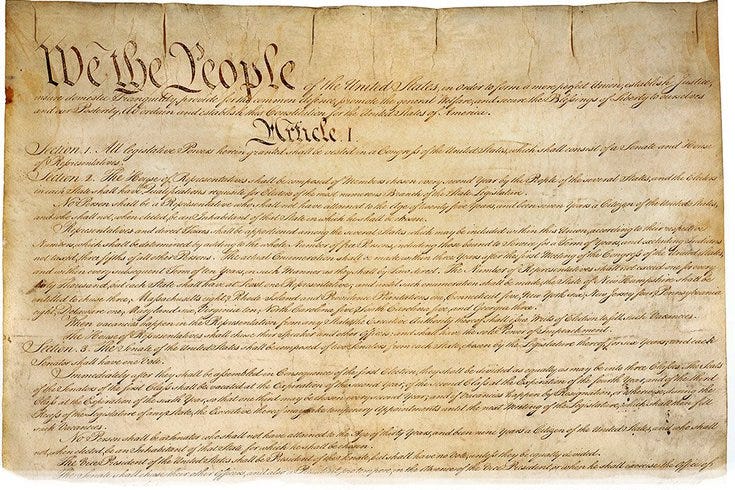
Democracy in America, Volume 1, Part I, Chapters 6, 7, 8 up to “On the Federal Courts”
American liberty depends not on weakening government, but on distributing power among institutions that possess different sources of authority, different modes of action, and different incentives.
That principle runs through Tocqueville’s discussion in these chapters of the judiciary, impeachment, the federal Constitution, Congress, and the presidency. Dividing power and weakening government are distinct constitutional projects; enumerating separate branches and assigning powers to each is a beginning, not a finished design. His subject is a government capable of acting, but prevented from acting unilaterally through a single, undivided will.
In this semiquincentennial year, reading these chapters is instructive and occasionally unsettling. Tocqueville arrived in 1831, fifty-five years after the Declaration — close enough to observe its institutional experiments still running, far enough to assess which arrangements had taken root and which remained fragile. What he found was a living system, a work in progress, sustained as much by political habit as by constitutional text. He also issued warnings that two and a half centuries of republican experience have done nothing to make less relevant.
Judges as a Political Power
Tocqueville begins with the judiciary because he considers it one of the most original features of the American system. He identifies three characteristics that judicial power shares across nations: courts act only when called upon; they pronounce on particular cases rather than general principles; and they can move only when a dispute is brought before them (p. 94). These limits confine the judiciary and distinguish it from legislative or executive action.
Yet within those limits, American judges possess an extraordinary political power found nowhere else: the right to decline applying a law that conflicts with the Constitution. Understanding why requires understanding the constitutional theory that makes it possible.
Tocqueville contrasts three models. In France, the constitution was treated as immutable; no ordinary power could alter it, which meant courts had no standing to test legislation against it. In England, Parliament’s authority is unlimited; it can modify the constitution at will, which means, in a sense, that no constitution exists apart from Parliament’s current preferences. The American arrangement is different in kind from both. The Constitution is neither immutable nor alterable by ordinary legislative means. It is, as Tocqueville puts it, a “work apart” (p. 95):
An American constitution is not considered to be immutable, as in France; it cannot be modified by the ordinary powers of society, as in England. It forms a work apart that, representing the will of all the people, binds legislators as well as ordinary citizens; but it can be changed by the will of the people following established forms and in cases for which provisions have been made.
This structure makes judicial review both coherent and necessary. When a judge gives priority to the Constitution over a statute, that judge is not claiming sovereignty over the people. The judge is giving effect to the people’s higher and more durable act over the temporary decision of their representatives. And by forcing that challenge to occur through particular cases rather than abstract rulings, the American system shields the judiciary from appearing to attack the legislature directly, preserving both judicial legitimacy and the political independence that makes review meaningful.
The result, Tocqueville observes, is one of the most powerful barriers ever raised against the tyranny of political assemblies. The power is immense precisely because it is constrained in its form of exercise.
Political Judgment and Its Dangers
Tocqueville next examines impeachment, which he calls political jurisdiction or judgment, depending on the translation. The House accuses; the Senate judges; but the tribunal cannot impose ordinary criminal punishment. Its reach extends only to removal from office and disqualification from future service. Criminal liability remains with the ordinary courts.
He interprets this arrangement as fundamentally administrative rather than judicial in character — a means of withdrawing power from someone making poor use of it rather than punishing a crime (p. 102). The American system surrounds this administrative act with the solemnity and guarantees of a judicial proceeding, while withholding the harshest sanctions that make political jurisdiction dangerous elsewhere.
The formal structure is orderly: House accuses, Senate judges, courts punish — each action separated from the others. But Tocqueville’s actual judgment is more disquieting.
Precisely because American political jurisdiction is limited to administrative removal, it becomes more available, more regular, and more tempting as an instrument of majority will. A legislature empowered only to remove officials, not to imprison or execute them, faces fewer inhibitions against using that power frequently. The moderation of the penalty reduces the political cost of wielding it. Americans may have avoided the most violent consequences of legislative tyranny while leaving in place something potentially as dangerous: a removal mechanism convenient enough to serve as a routine instrument of factional control (p. 104).
His conclusion/hypothesis is among the most arresting in these chapters. When the American republics begin to degenerate, Tocqueville argues, the early sign will be easy to identify: an increase in cases of political jurisdiction. The institution designed as a constitutional safeguard carries within it the mechanism of its own abuse.
A Government Made from Governments
Chapter 8 turns to the federal Constitution and the framers’ core challenge: creating a national government capable of acting on individuals without absorbing the states that had authorized it.
The states preceded the Union. They were existing political societies with governments, laws, and sovereign claims. They delegated specific powers to a federal government while retaining the rest. The result was not a centralized nation divided into administrative provinces but a federal republic in which two orders of government acted on the same people — each legitimate within its own sphere.
The framers’ practical solution was giving the national government powers that acted directly on citizens rather than through state intermediaries. Without that direct reach, the Union would depend on state cooperation to carry out national decisions, possessing the form of government without the means. The Articles of Confederation had demonstrated exactly that failure, as Tocqueville notes (p. 106).
American federalism joined two goods that typically resist combination: national capacity for common action and state independence for local self-governance (p. 109). Governing a continental republic from a single center would have been epistemically impossible, requiring knowledge of things no single center could know. Federalism was not merely a political compromise; it was an institutional acknowledgment that self-governance at scale requires distributed knowledge and distributed authority. Vincent and Elinor Ostrom would later formalize this concept as polycentricity: a system of multiple governing centers, each possessing its own legitimacy and logic, producing order through their interaction rather than through hierarchical command. Tocqueville never uses that language, but he sees the thing it names. American republican government works not because a single authority optimally designs all outcomes, but because many authorities, checking and informing each other, arrive over time at arrangements superior to what any one of them could have devised alone.
Yet Tocqueville is careful not to present this as a self-sustaining design. No law, he observes, can foresee everything; institutions cannot substitute for reason and mores. The constitutional architecture depends on something the architecture itself cannot provide.
Executive Power and the Problem of Re-election
Within the federal government, power was divided again. The House represents population directly; the Senate gives equal representation to states and introduces deliberative stability. Bicameralism requires majorities to form through different channels, a test that slows legislation while screening for breadth and durability (p. 111).
The presidency supplies unity and energy that a legislature cannot. But Tocqueville is emphatic about the president’s subordinate position: “The president stands beside the legislature as an inferior and dependent power” (p. 117). In everything essential, the president is directly or indirectly subject to Congress. The executive’s weakness, not its strength, allows a president to govern in opposition to the legislative power (p. 119). This observation cuts sharply against two centuries of subsequent executive aggrandizement.
Institutional power also shifts with circumstances. In foreign affairs and national crisis, the executive’s advantages — unity, speed, secrecy, continuity — come into their own. In ordinary domestic governance, Congress occupies the stronger position. The balance is dynamic, not fixed.
A president’s re-election eligibility disturbs that balance in a specific way. A president seeking a second term is simultaneously a candidate: reading public opinion, managing allies, distributing favor, and calibrating every significant decision against its electoral effect. Governing by principle and governing toward re-election are not always compatible, and the incentive to survive politically tends to prevail. The structure converts private ambition into a reason to deploy public authority for partisan ends, not through corruption in the ordinary sense, but through the mechanism of treating electoral responsiveness as its own justification.
The Constitution as Information Architecture
These chapters speak with unusual force to a republic in its 250th year.
Political authority has shifted toward the executive across recent decades. Presidents govern through administrative agencies, emergency declarations, and broad interpretations of delegated statutes. Congress retains formidable constitutional powers but frequently declines to use them, choosing instead to state aspirational goals while leaving the executive to determine how those goals will be achieved. Claiming credit for the aspiration while avoiding accountability for the tradeoffs is individually rational behavior. When it becomes collectively routine, the constitutional order changes in ways no individual legislator chose and no individual legislator can reverse. And yes, for the game theorists among you, I would indeed characterize Congress today as being in the inferior outcome of a Prisoner’s Dilemma.
The result is poorly ordered government: sweeping executive action followed by litigation, reversal, and another sweeping action from the next administration pointed in the opposite direction. Each cycle erodes institutional legitimacy and the practical capacity to make durable policy.
Tocqueville’s analysis offers a diagnostic framework grounded in something deeper than procedural preference. Each branch’s distinctive mode of action is also a distinctive mode of processing political knowledge. Congressional deliberation aggregates diverse preferences through bicameral bargaining. Courts reason from rules and precedent, producing the predictability that makes planning possible. States govern with local knowledge no national institution possesses. When Congress surrenders its legislative function to administrative agencies, it does not merely lose power; it eliminates an information structure, replacing distributed deliberation with concentrated executive discretion. Policy made without deliberation is likely to be worse policy, not merely less procedurally legitimate policy.
The founders understood this, Tocqueville argues, and their clearest achievement was the courage to act on it. Beyond the people, they established powers capable of refusing the majority’s dangerous demands — powers that, while ultimately deriving from the people, enjoyed enough independence within their sphere to struggle against caprice. That, he writes, is the greatest glory of the American people: knowing how to appreciate that truth, and submitting to it (p. 129).
When the American republic begins to degenerate, Tocqueville hypothesized, an early sign will be the growing use of political jurisdiction. Although the modern history of impeachment is too complicated to fit that prediction neatly, his deeper warning remains relevant. Conflict between Congress and the presidency now takes the form of accusation, investigation, litigation, and judgment, while the ordinary work of deliberation, legislation, oversight, bargaining, and administration deteriorates. Two hundred and fifty years on, Tocqueville’s insight requires less correction than refinement: constitutional dysfunction appears not only when impeachment becomes common, but also when political institutions judge one another instead of governing together.