Reading Tocqueville at 250
Democracy, civic virtue, and the American experiment in a polarized age

[Note: I plan to continue writing about my usual obsession with the theory and practice of regulatory economics in the face of technological change; whether or not this means two articles a week will depend on my other work commitments.]
This summer marks the 250th anniversary of the Declaration of Independence.
That fact alone is astonishing: a republic born in rebellion against monarchy survived civil war, depression, world wars, constitutional crises, social upheaval, and the immense pressures of industrialization, globalization, and technological change. The American experiment has endured longer than many of the democracies that once dismissed it as unstable or naïve. I celebrate that endurance enthusiastically and gratefully.
And yet this anniversary arrives at a strange and dispiriting moment. Americans today often seem less capable of living together as fellow citizens than at almost any point in recent memory, as Lauren Hall has documented effectively (in two articles here and here). Our politics has become intensely polarized, but polarization alone is not the deepest problem. Democracies have always contained conflict, disagreement, and faction.
Contempt is the deeper problem.
Too many Americans increasingly regard political opponents not merely as wrong, but as morally illegitimate, intellectually corrupt, or fundamentally alien. Public life often feels less like democratic disagreement among fellow citizens and more like tribal warfare funneled into two camps and conducted through institutions that both sides increasingly distrust.
I share Lauren’s despair about this condition. But I also think the crisis runs deeper than contemporary politics, election cycles, or social media incentives. What we are witnessing is, in part, the erosion of civic virtue.
That phrase has acquired an unfortunate ideological coding in modern political discourse. “Civic virtue” is often interpreted as a conservative slogan or, worse, as a moralizing demand for conformity. I think that interpretation badly misunderstands the concept. Civic virtue is not partisan. It is not reducible to politics. And it is not fundamentally about agreement.
At its core, civic virtue rests on two simple but profound premises that are fundamental to the American project. First, every person possesses dignity as an individual human being. Second, human beings are social creatures who must live together in communities, cooperating in countless ways even amid disagreement. We rely on each other not only emotionally and culturally, but also materially and politically. We maintain institutions (informal and formal) together. We build infrastructure together. We govern together. We inherit constitutional orders together. A liberal democracy cannot survive without some shared commitment to those truths.
This idea lies at the heart of the American founding itself. The Declaration of Independence is not merely a legal document announcing separation from Britain. It is a moral claim about human equality and human dignity. The proposition that “all men are created equal” asserts that individuals possess inherent worth and therefore deserve liberty, protection under law, and recognition as moral equals. It is an aspirational statement of a set of core values and a yardstick for our moral improvement in achieving those values.
That tradition is fundamentally liberal in character. It joins liberty with dignity, rights with responsibility, and individual freedom with mutual obligation.
But we live in a political culture saturated with outrage, suspicion, and performative antagonism, so that moral foundation increasingly feels fragile. Many Americans now encounter fellow citizens primarily through nationalized ideological conflict rather than through local civic life, neighborhood institutions, religious congregations, voluntary associations, or community organizations. We increasingly experience one another as abstractions rather than as human beings.
Alexis de Tocqueville saw this danger nearly two centuries ago, and that recognition is one reason I want to reread him now. Revisiting Tocqueville during the semiquincentennial year can help reanimate the ideas and ideals embodied in the Declaration of Independence as an aspirational statement of values.
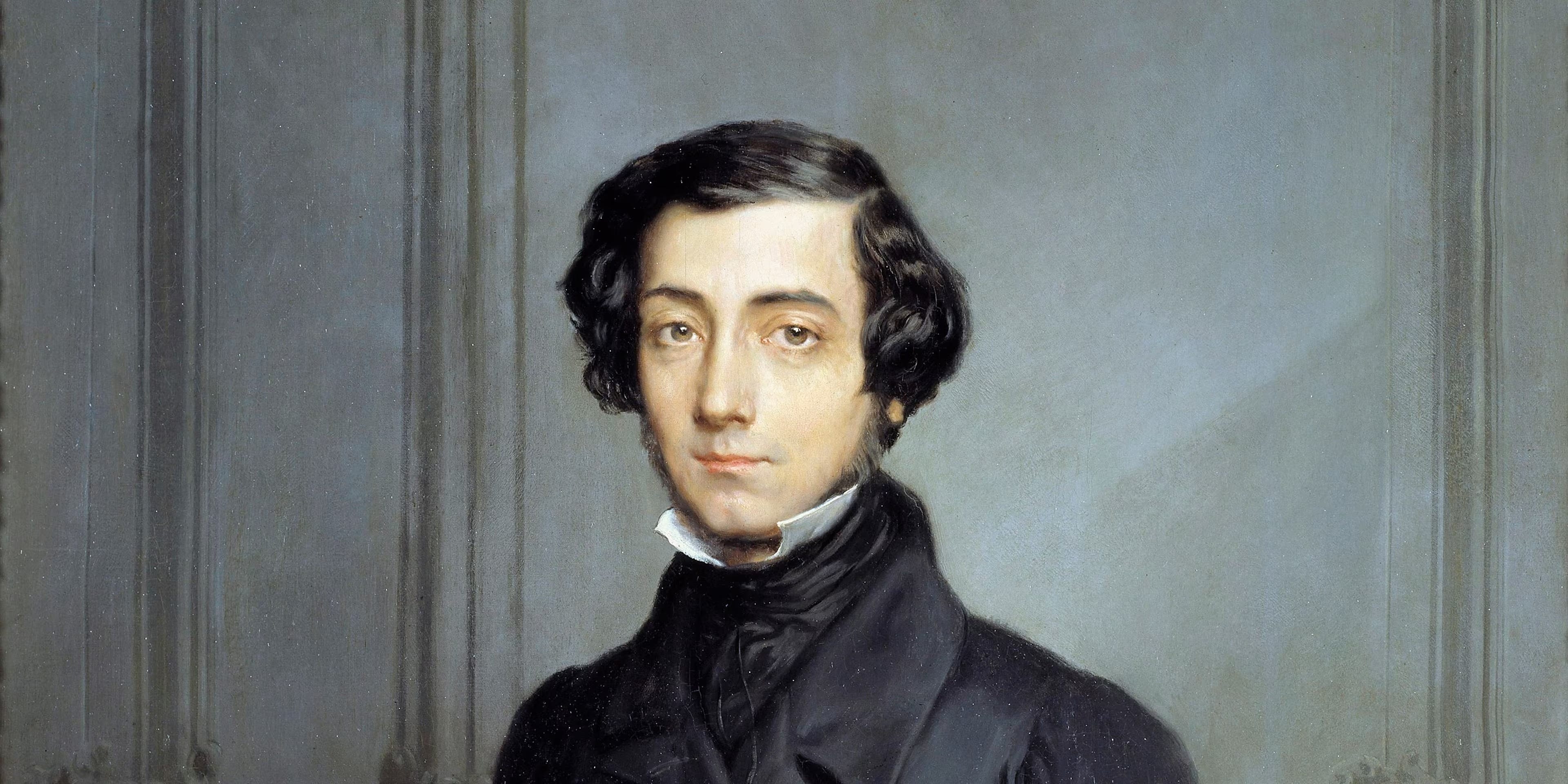
Alexis de Tocqueville (1805–1859) was a French aristocrat turned political thinker, historian, and statesman. He is best known for Democracy in America, a work that remains one of the most penetrating analyses of democratic society ever written, as Brendan McCord of the Cosmos Institute has argued recently. Tocqueville was a comparative social scientist avant la lettre, asking how modern democracy reshapes law, culture, religion, and everyday life.
Reading Democracy in America today can be almost unsettling because of how contemporary many of its warnings feel. Tocqueville admired American democracy deeply, but he also understood its vulnerabilities with remarkable clarity. He recognized that democratic equality could elevate human dignity while simultaneously weakening the habits and institutions necessary to sustain liberty.
Most importantly, he understood that democracy depends upon culture and character as much as upon constitutions and laws. Americans often assume that liberal democracy survives through formal institutions alone: elections, courts, constitutions, and procedures. Tocqueville thought those institutions mattered enormously, but he also believed they were insufficient in and of themselves. Free societies require mores, habits, associations, local institutions, and civic norms that teach citizens how to govern themselves. Democracy requires civic virtue.
Tocqueville famously observed the role of civil society in the young American republic. Today, many of the mediating institutions Tocqueville admired have weakened simultaneously: local journalism, civic organizations, churches, neighborhood associations, and geographically rooted communities. Americans participate less in shared local life while consuming more national political conflict. The result is a society filled with people who are hyper-politicized yet civically disconnected.
Tocqueville believed Americans historically counteracted some of the corrosive tendencies of democratic individualism through the density of their associational life. Americans formed clubs, churches, reading groups, charities, local organizations, and civic associations for nearly every conceivable purpose. These institutions did more than accomplish practical tasks. They taught citizens habits of cooperation, compromise, responsibility, and mutual respect. They taught people how to disagree while still regarding one another as fellow citizens.
The tragedy of our present moment is not merely that Americans disagree passionately. Democracies are supposed to contain passionate disagreement. The tragedy is that many citizens increasingly struggle to imagine political opponents as participants in a shared constitutional project, which is precisely why Tocqueville matters today.
Reading Democracy in America offers both historical insight and a kind of civic reorientation. Tocqueville approaches democracy neither with blind celebration nor with cynical contempt. He combines admiration with warning, hope with realism, and criticism with genuine affection for democratic life. He writes with humility. He even writes about technology, which you know I am going to want to discuss!
Tocqueville understood that democracy is fragile because human beings are fragile. Free societies depend upon habits of restraint and mutual recognition that no formal constitution can compel. A people incapable of respecting one another eventually becomes incapable of governing itself. That observation feels painfully relevant during this 250th anniversary, and it is one reason I think reading Tocqueville today is an important civic exercise.
At a time when contempt increasingly dominates public life, Democracy in America reminds us that liberal democracy requires something deeper than procedural rules or electoral victories. It requires citizens capable of balancing liberty with responsibility, individuality with community, and disagreement with mutual respect.
Tocqueville recognized both the greatness and the danger embedded within the democratic revolution in America. We would do well to read him again.
That is what I plan to do, and I invite you to join me.
I will be reading the copy I have, which is the University of Chicago Press Mansfield/Winthrop translation (2000), as well as Schleifer’s companion (2012). Electronic copies of Democracy in America are available at the Liberty Fund website, a 2010 new translation in four volumes. So if you want to read along with me and don’t have the same edition, the pagination won’t match but the chapter numbers should.
A small sentimental recollection: this volume of Tocqueville was one my father purchased on a visit to us in 2000, shortly after its publication, when it was one of the new publications featured on the front table at the Seminar Co-Op Bookstore at the University of Chicago (back when it was still in the basement of the old seminary building). I don’t know how much he read it; it doesn’t have any marginalia. I inherited it from him when he died in 2006.
Here’s my schedule starting next week, if you would like to read along and have a Tocqueville book club (which I would love):
Essay 1
Volume 1, Part 1, Chapters 1–2 (42 pages)
Essay 2
Chapters 3–5 (48 pages)
Essay 3
Chapters 6–8 (through “On the Federal Courts”) (37 pages)
Essay 4
Remainder of Chapter 8; Part 2, Chapters 1–3 (50 pages)
Essay 5
Chapters 4–5 (40 pages)
Essay 6
Chapters 6–8 (44 pages)
Essay 7
Chapter 9; Chapter 10 through the section on slavery (61 pages)
Essay 8
Remainder of Chapter 10 (73 pages)
Essay 9
Volume 2, Part 1, Chapters 1–12 (44 pages)
Essay 10
Chapters 13–21 (34 pages)
Essay 11
Volume 2, Part 2 (entirety) (56 pages)
Essay 12
Part 3, Chapters 1–15 (47 pages)
Essay 13
Chapters 16–26 (54 pages)
Essay 14
Part 4 (entirety) (38 pages)
Essay 15
Analysis, synthesis, and contemporary relevance
Please do join me!
There's a Cambridge Companion too but it's $39 on the Kindle (multiple authors). The Chicago Companion is $2.99. Here are the links for the two books:
DEMOCRACY IN AMERICA, VOL1 AND 2 BY ALEXIS DE TOCQUEVILLE
https://a.co/d/09EIVS9C
THE CHICAGO COMPANION TO TOCQUEVILLE’S DEMOCRACY IN AMERICA
https://a.co/d/0azvdIi1
Excellent way to celebrate America’s 250th. FYI, 3 versions of Democracy in America are free to purchase in the Kindle book format. The Chicago Companion is $2.99 as a Kindle book.