Repairable Mistakes: Tocqueville on Democracy’s Self-Correcting Institutions
Essay 6 in Reading Tocqueville at 250

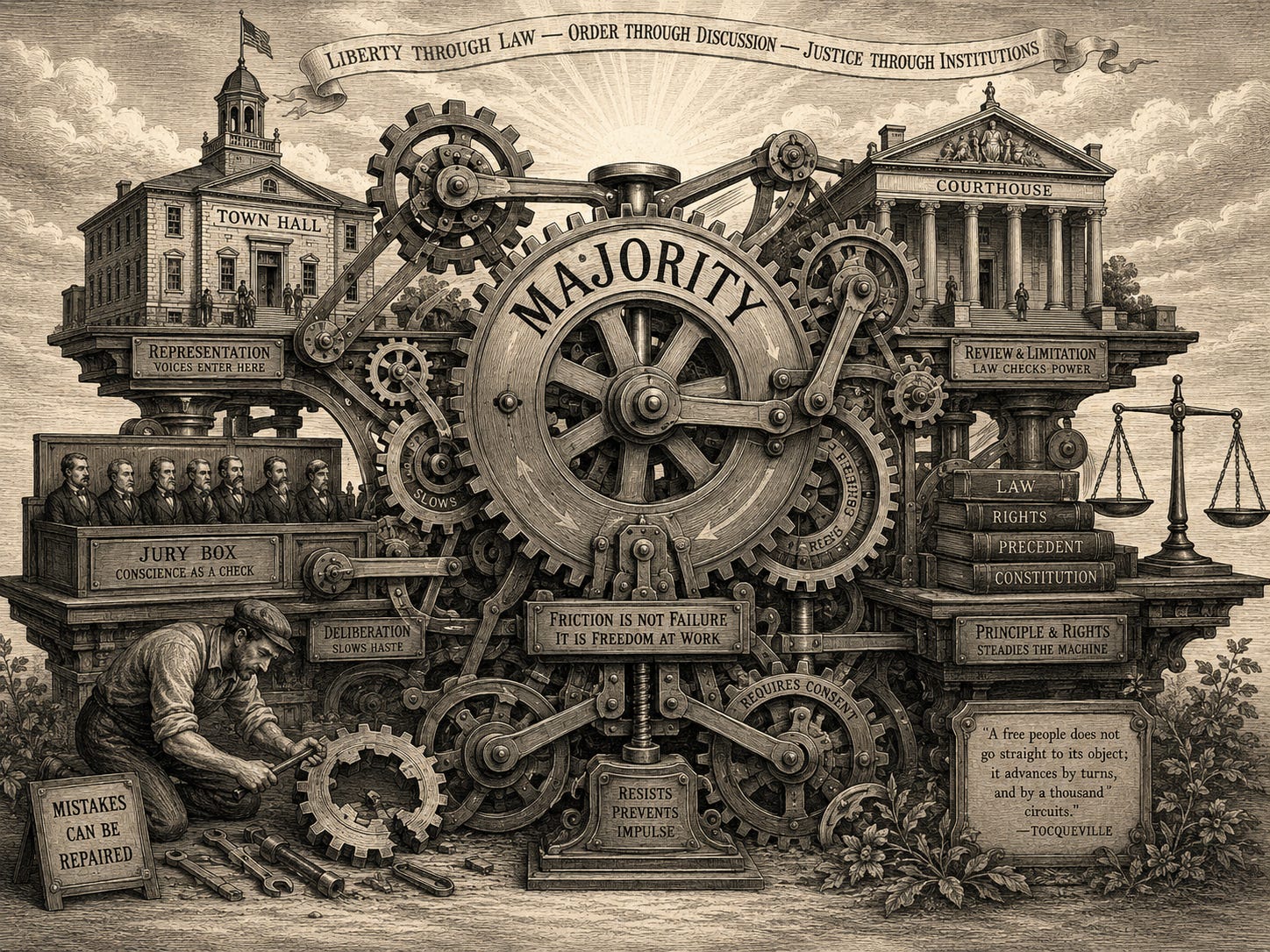
Source: ChatGPT’s conception of “repairable mistakes” and self-correcting democratic institutions. I have some disagreements with some of the characterization and language here (and the quotes felt a little Orwellian to me, especially in the banner), but I thought it was thought-provoking enough to include it as is! What do you think?
Reminder: I am using multiple translations; my main reading is from the hardbound copy of the Mansfield translation. When I refer to page numbers it’s to the Mansfield translation, and when I want to pull quotes that are longer I’ll use the online Schleifer translation, so the text may not match exactly but they are close (and I also read French so I calibrated across the translations to get comfy with Tocqueville’s word choice).
Part II, Chapters 6 through 8 of Democracy in America build on each other into a more coherent and insightful progression than I honestly was expecting from these chapters. Tocqueville asks first what democratic government does well, then turns to its central danger, the omnipotence of the majority, before closing with the institutions that temper that danger. If you read them in isolation, these chapters look like praise, then warning, then reassurance. Read together, they form an argument about democratic self-correction. Democracy’s advantage lies not in avoiding error but in retaining, through the right formal and informal institutions, the capacity to recognize mistakes and change course without surrendering self-government. This progression and its dynamic feedback effects marks Tocqueville as an evolutionary institutionalist.
Democracy’s real advantage
Chapter 6 opens with an asymmetry: democracy’s faults are visible immediately, while its virtues only become apparent through experience. Tocqueville concedes that aristocracy will generally out-legislate a democracy due to better training, more continuity, more leisure for the work of governing. But skill in lawmaking is not the same as justice in purpose, and his claim is comparative: “The real advantage of democracy is not, as has been said, to favor the prosperity of all, but only to serve the well-being of the greatest number” (p. 223). Majoritarian rule does not harmonize every interest, but it does shift government toward a wider slice of society than aristocratic rule does.
Is Tocqueville being a bit idealistic here? A broader beneficiary class is not the same as a just one, and he knows this. He has a sharper point, though, that I think is one of the most important insights in these three chapters: “the great privilege of the Americans is to be able to have repairable mistakes” (p. 222). Democracy serves people by keeping its errors reversible: bad laws repealed, poor officials removed, failed policies revisited, local experiments contained before they become national ones. Opening governance to more people invites more error, and uncertainty makes some of that unavoidable regardless of who governs. What matters is that the errors stay cheap to fix.
That privilege has a condition attached, which Tocqueville spends the next two chapters complicating. Mistakes stay repairable only so long as the machinery of repair stays intact. A society can enact a bad law and later reverse it, or it can weaken rights, erode legal constraints, centralize authority, and punish dissent, wearing down its own capacity to notice and fix future errors. Repairability is not fixed or guaranteed. It has to be maintained.
Tocqueville grounds this maintenance process in rights: “The idea of rights is nothing other than the idea of virtue introduced into the political world” (p. 227). Rights set a moral ceiling above both self-interest and majority will, and democracy’s distinctive achievement is making that ceiling something ordinary citizens actually practice against, rather than something only elites understand. I found this idea abstract and confusing, but his analogy to property rights helped: “The government of democracy makes the idea of political rights descend to the least of citizens, as the division of property puts the idea of the right of property in general within reach of all men” (p. 228).
Citizens learn liberty the way they learn anything difficult: by practicing it, defending it, and living its reciprocal obligations (and in our time, I think too many of us forget those reciprocal obligations). “There is nothing more fruitful in wonders than the art of being free,” Tocqueville writes, “but there is nothing harder than apprenticeship in liberty” (p. 229). Despotism, by contrast, arrives promising order and quick relief, comforting now and only later revealed as costly. Liberty’s origins are usually tempestuous, and its benefits show themselves only with time and maturity.
This contrast explains one of Chapter 6’s more striking claims. Democracy’s greatness, Tocqueville argues, shows up less in what government executes than in what citizens accomplish outside it: an “energy that never exists without it and that, if only circumstances are favorable, can bring forth wonders” (p. 234). Measuring government purely by administrative output misses the point. The relevant question is what the institutional order frees citizens to do on their own.
From majority rule to majority omnipotence
Chapter 7 turns from democracy’s energy to its power. The same restless activity that Chapter 6 celebrated becomes, if unchecked, the source of Chapter 7’s danger: tyranny of the majority.
Tocqueville is not opposed to majority rule; some decision procedure is necessary, and majority rule fits democratic equality. His target here is majority omnipotence, the belief that a majority may act without obstacle and treat its will as the final measure of justice. “Omnipotence in itself seems to me something bad and dangerous. Its exercise seems to me beyond the power of man, whoever he may be” (p. 241). No earthly authority, whatever its source, is wise enough to hold unlimited power safely, a claim I find persuasive on both epistemic and moral grounds.
His diagnosis of America is correspondingly counterintuitive: “What I most criticize about democratic government as it has been organized in the United States is not its weaknesses... but on the contrary, its irresistible strength” (p. 241). The danger is not too much liberty. It is too little guarantee against tyranny, because the same majority reaches the legislature, the executive, and public opinion all at once.
That last point worries him the most, since democratic tyranny doesn’t have to censor anyone. It can just make dissent expensive. “As long as the majority is uncertain, people speak, but as soon as the majority has irrevocably decided, everyone is silent” (p. 243). That silence is as much an epistemic failure as a political one. Once disagreement disappears, officials hear only their own opinions echoed back, and democracy loses its capacity to test itself. Tocqueville reports finding startlingly little “independence of mind and genuine freedom of discussion” in America (p. 244), and describes a “courtier spirit” spreading through democratic society: where courtiers once flattered kings, politicians and writers now flatter the public.
Self-correction depends on friction, on someone being willing to say a decision is wrong. Majority tyranny does its worst damage exactly where it disables the mechanisms that would otherwise supply that friction.
Democracy correcting democracy
Chapter 8 answers the problem Chapter 7 raises. The American majority may have “the tastes and instincts of a despot,” but it “still lacks the most perfected instruments of tyranny” (p. 250), and Tocqueville credits three institutions with keeping it that way.
The first is administrative decentralization, which limits the reach of majority opinion. Local governments and overlapping jurisdictions create friction between what a majority wants and what gets executed, containing the damage of any single bad decision rather than preventing bad decisions from occurring.
The second is the influence of lawyers, whose professional habits — precedent, procedure, continuity, formal reasoning — slow the passage from popular desire to political action. Tocqueville sees this working through the inherited structure of English common law, adapted and carried forward in America: change happens, but embedded in institutional memory via precedent rather than improvised from scratch. Lawyers as stewards of self-correcting democratic institutions may be the nicest thing anyone has ever said about them!
The third, and the one Tocqueville treats most affectionately, is the jury, which he sees simultaneously as a judicial and a political institution. Jurors listen, weigh evidence, apply general rules to particular facts, and answer for the consequences. The jury moderates democracy by involving citizens in judgment rather than excluding them from power, a paradox Tocqueville captures in one of the best lines in these chapters: “the jury, which is the most energetic means of making the people reign, is also the most efficacious means of teaching them to reign” (p. 264).
That sentence closes the circle opened in Chapter 6 by “repairable mistakes”. Rights teach reciprocity, decentralization contains error, lawyers carry memory, and juries teach judgment — four institutions, doing different jobs, all disciplining the exercise of majority will without ever silencing it. None of the four legislates virtue directly; each cultivates it, building the patience, the tolerance for dissent, and the willingness to lose an argument that repairable mistakes ultimately depend on.
In these three chapters, Tocqueville’s defense of democracy rests on adaptability, not wisdom. A free society stays capable of repair only as long as it protects the institutions that make repair possible. That, more than any particular law or policy, is the argument worth carrying forward.