The Distributed Grid and the End of the One-Way Electricity System
Michael Lee's practical take on the evolution of the utility business model

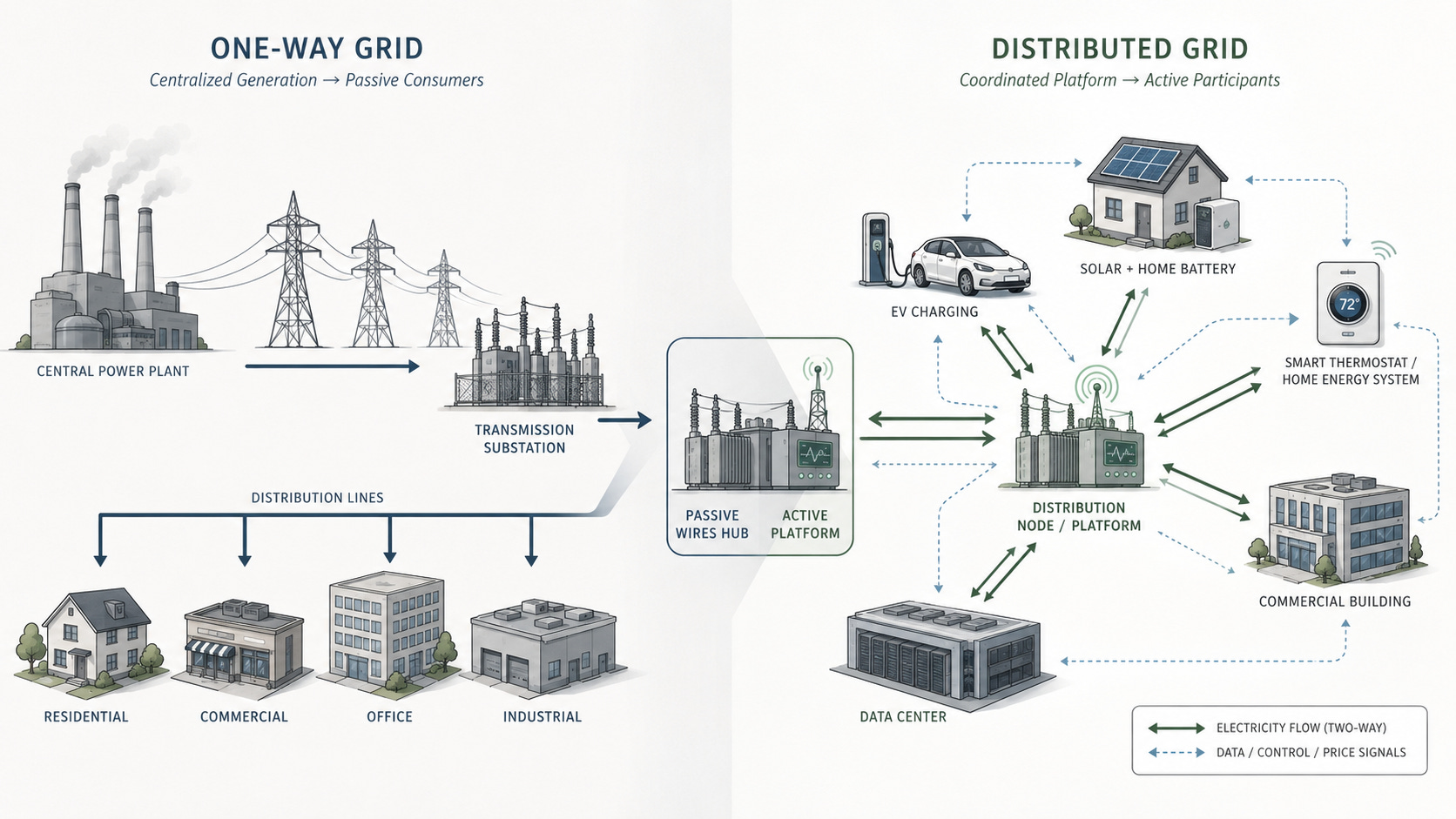
Source: An iterative conversation about Michael’s series with ChatGPT
Michael Lee’s Distributed Grid series reads like a field report from the institutional frontier. Lee, formerly CEO of Octopus Energy US, is writing from inside the practical problem that has animated my work for decades: how do we build a power system in which customers, new technologies and resources, flexible loads, and digital control and automation become working parts of a more adaptive grid? Reliability, affordability, and abundance will depend increasingly on that coordination.
Lee’s answer, across the first seven essays in his planned ten-part series, is that the next utility will not look like the old utility. It will look more like a platform business — a coordinator of capabilities, transactions, information, contracts, and performance across a dynamic network of resources the utility does not necessarily own. That vision gives operational specificity to a broader institutional-economic transition I have been writing about for over two decades. The grid’s future is decentralized coordination.
Lee begins with the utility business model. His first essay makes the crucial point that the investor-owned utility is built for a different era because its core financial incentive still rewards capital deployment more than customer value. Traditional cost-of-service regulation does not simply allow utilities to build; it creates a business model in which building is the primary path to earnings. New substations, feeders, transformers, and other capital assets enter rate base. Less visible substitutes — flexible demand, distributed batteries, non-wires solutions, better information, or third-party coordination — may reduce total system cost but generate no equivalent durable earnings stream.
Lee is careful, and rightly so, not to frame this as a morality play. Utility executives and employees are not villains; they are organizations responding to incentives. The rate-base model did what it was designed to do: it financed a capital-intensive universal network. The problem is that the task has changed. Rather than an institutional framework that induces building large assets, we need an institution capable of discovering when building is the best answer, when operating differently is, and when customers and third parties can solve problems more cheaply and quickly.
This framing is where Lee’s practitioner critique meets the knowledge problem perspective. In my 2009 book, Deregulation, Innovation and Market Liberalization, I argued that the traditional natural-monopoly model is inherently static and poorly suited to a system characterized by technological change, heterogeneous agents, diffuse private knowledge, and evolving institutions. The fundamental economic problem in electricity is not allocating known resources to known uses. It is coordinating the actions and plans of people and organizations who know different things, value different things, and face changing technological possibilities.


Lee’s second essay, on performance-based regulation, pushes that analysis further. PBR is often presented as the corrective to cost-of-service regulation: pay utilities for outcomes rather than inputs. Lee’s contribution is to show why that reform, while directionally right, is often too small to change behavior. If a utility can earn large, durable returns from rate-base growth but only small, episodic rewards from performance incentives, the basic earnings logic remains intact. A modest performance incentive sitting beside a much larger capital incentive decorates the old model with a new ribbon. It does not transform the organization.
That diagnosis connects to a central finding in the economics of rate-of-return regulation: cost-of-service rules encourage capital investment even when capital is not the best path to reliability, resilience, affordability, or innovation. Lee adds the organizational mechanism, showing that a utility optimized around capital deployment will have planning, engineering, accounting, and managerial routines reinforcing that deployment. Changing the metric is not enough. The business model has to make operational excellence, flexibility procurement, and customer value financially consequential.

Lee’s third essay applies cost causation to one of the most important current stress tests for the grid. He argues that data centers should fully pay their own way, particularly when new large loads drive upstream transmission, substation, or distribution upgrades. His core intuition is sound: if the system met reliability standards before the new load arrived, upgrades required to maintain reliability afterward are caused by that load.
I agree with Lee that cost causation should discipline the data center debate, although I would put more weight on the institutional problem these loads reveal. Data centers expose a pacing mismatch: they can be built in 18–24 months, while major grid infrastructure often requires 7–10 years. That mismatch is a coordination problem under uncertainty; ignoring workload shifting in time and place, UPS-based frequency response, hybrid on-site generation, and other capabilities that can reduce system stress and upgrade costs, just makes it worse.
Here the Lee framework and my data center flexibility work converge. The question is not whether data centers should receive subsidies through socialized grid costs — they should not. The question is whether our rules can distinguish between large loads imposing rigid peak demands and large loads capable of offering flexibility, speed, and grid support. Cost causation and flexibility valuation have to work together, or we will either socialize too much cost or push customers toward inefficient bypass.

Lee’s fourth essay turns from data centers to what he sees as the larger opportunity: the distribution grid. Public debate remains fixated on bulk generation, long-distance transmission, and large loads, which are important. But the distribution system is where customers experience reliability, where many costs accumulate, where DERs connect, and where local constraints can often be resolved by local capabilities.
Lee emphasizes distribution-system load factor, observability, and topology. Distribution infrastructure is built for peaks occurring only a small fraction of the year. Without real-time topology, granular metering, and operational visibility — all achievable now through digital technologies — DERs remain blurry objects on the edge of the system rather than usable grid resources. Engineering conservatism and capital bias compound each other under poor observability, producing more iron rather than better coordination.
Lee’s fifth essay is deliberately pro-DER while also anti-hype. He is bullish on distributed energy resources, bearish on the infrastructure around them, and that distinction has meaning. Rooftop solar, batteries, electric vehicles, smart thermostats, and flexible devices can create system value, but not by existing heroically in PowerPoint slides. They need telemetry, data access, locational compensation, workable interconnection processes, OEM cooperation, and distribution-level price signals. Without that institutional and technical infrastructure, DERs remain potential rather than capability.
This institutional gap explains why flexibility remains the missing economic category in so many electricity debates. The old system valued energy and capacity. The emerging system also has to value capabilities: the ability to shift, reduce, inject, absorb, store, substitute, and orchestrate electricity use across time and space. The analysis must shift from a resource’s physical capacity to its capability to perform a specific service at a specific time and location, treating flexible demand not as a burden to be satisfied but as one of the system’s most valuable resources. What matters is not just how many kilowatts exist, but what they can do, how fast, and where they are in the network.
Lee’s sixth essay identifies the institutional precondition for this world: transparency as an operating model, not public relations. Utilities ultimately sell trust because customers cannot see electricity, often lack competitive alternatives, and receive bills whose causes are opaque. Distribution constraints, hosting capacity, feeder loading, engineering assumptions, interconnection queues, and performance data have to become legible to qualified participants if third parties are going to propose alternatives and if regulators are going to evaluate whether utilities are delivering value.
This necessity connects directly to what I have called the pacing problem in electricity. Technologies are changing faster than regulatory institutions can metabolize them. DERs, data centers, automation, AI, batteries, EVs, and digital control systems are evolving through modularity and recombination, while regulatory processes still move through rate cases, prudence reviews, tariff filings, and contested proceedings. Institutions need stability, but they also need adaptive capacity — otherwise the system gets ossification or chaos, and neither keeps the lights on.

That brings us to Lee’s seventh essay, where the platform vision becomes explicit (a vision my co-authors and I analyzed in our “From Airbnb to Solar” paper (Theisen, Kiesling, Munger (2022)). He imagines a distribution planning engineer facing a feeder constraint. In the traditional model, the engineer proposes a substation: capital investment, rate base, familiar process. In the platform model, the engineer opens a constraint marketplace. Storage developers, aggregators, flexible load providers, and conventional infrastructure options compete to solve the constraint on comparable terms, with each option evaluated on cost per unit of reliability delivered rather than on how much capital it adds to rate base.
That example is doing a lot of work. Converting the utility from a builder of owned assets into a coordinator of solutions creates a way for the utility to earn by saving customers money rather than by expanding rate base, treating third-party resources as complements rather than irritants, and recognizing that the cheapest reliable solution to a grid problem may sit in software, customer behavior, distributed storage, reconductoring, or traditional capital investment. The point is not to privilege DERs over wires. The point is to discover the least-cost, best-performing portfolio of capabilities.
In my 2020 paper “Plug-and-Play, Mix-and-Match: A Capital Systems Theory of Digital Technology Platforms,” I argued that digital platforms create value through modularity, scalability, and adaptability — a stable core, standardized interfaces, heterogeneous edge participants, governance rules, and mechanisms for matching capabilities to needs. That architecture applies directly to the grid edge: devices must communicate, market participants must know what services are needed and what those services are worth, and utilities must have incentives to publish constraints and treat edge resources as working parts of the system.
The hard part is that the wires monopoly still sits at the center of this architecture. Drawing on the Baxter/Bell Doctrine — that regulated monopolists have both the incentive and the opportunity to distort adjacent competitive markets — I have argued that the platform utility vision requires structural discipline. The utility may coordinate the platform, but absent regulatory constraint, using network control to foreclose competitive entry at the edge is the predictable response.

Lee’s series is important because it gives operational language to a transition that institutional economists have been analyzing from a more theoretical angle. He is describing the grid from the customer and distribution edge outward; my work has described the same transition from institutions and coordination inward. Those perspectives meet at the same point: a power system in which reliability, resilience, affordability, and decarbonization emerge not from suppressing decentralized action but from coordinating it.
The distributed grid is not a gadget story. It is an institutional story. The technology now exists to make millions of small decisions useful to the system. The question is whether regulation, markets, and utility business models will let that knowledge into the room.