Tocqueville's New World: Democracy Before It Becomes Politics
Essay 1 in Reading Tocqueville at 250

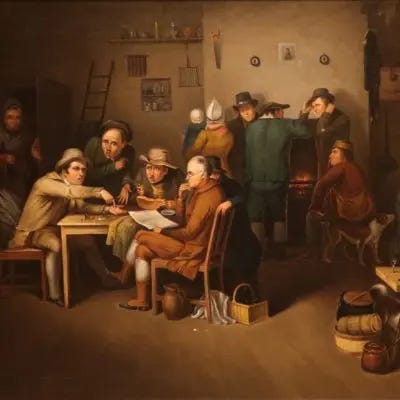
Source: Town Meeting 101, Discourse Magazine, 2022
Note: In this first essay I didn’t both with quotes and page references because I wanted to focus more on broad themes. If I am doing page references or quotes I’ll specify which edition and put a reminder in each article. And please do treat this like a reading club by sharing ideas and interpretations and implications in the comments!
Alexis de Tocqueville went to America in 1831 to discover democracy.
Democracy in America is often treated as a book about the United States, and of course it is. Tocqueville observed American geography, settlement patterns, town government, religion, slavery, newspapers, courts, parties, associations, manners, ambition, restlessness, and the habits through which democratic people learn, or fail, to govern themselves. America was the great case study; democracy was the real object of inquiry.
For Tocqueville, democracy is not merely a system of elections, reducible to majority rule, representative institutions, written constitutions, or popular sovereignty. Democracy is a social condition before it is a political form. It begins with what he called equality of conditions: the weakening of hereditary rank, the erosion of fixed social orders, and the gradual emergence of a world in which human beings increasingly see themselves as comparable, mobile, and entitled to judge their own affairs.
For that reason, Tocqueville began his great book in a way that can feel surprising to modern readers. He does not start with Congress, the presidency, the Constitution, or the mechanics of American elections. He begins with equality. He begins with social transformation. He begins with the most important fact, as he sees it, of the modern world.
The young United States of America was distinctive because equality of conditions had advanced further there than in Europe, and because it had done so under unusual circumstances. America, for Tocqueville, is democracy with fewer aristocratic ruins lying around. France had encountered democracy through revolution, violence, centralization, and the destruction of an old regime. America seemed to show democracy nearer its point of departure, before centuries of aristocratic hierarchy had so thoroughly complicated the landscape.
More than asking how America works, Tocqueville asked what happens to human beings when equality becomes the organizing fact of social life.
That question remains alive today, and may be more alive now than when Tocqueville posed it. We still live inside the world he was trying to understand: a world in which equality is morally powerful, liberty is rhetorically revered, freedom is demanded in private life, and democracy is invoked as both ideal and weapon. We often use these words as if they all meant the same thing. Tocqueville’s insight begins with his refusal to do that, and with his interrogation of them as distinct concepts.
Equality is not liberty
Tocqueville carefully separated concepts that modern political language tends to blur. Equality, liberty, freedom, and democracy are related but not synonymous. Much of Democracy in America is an extended meditation on how they reinforce one another, how they threaten one another, and how difficult it is to preserve liberty in a democratic age.
Equality, for Tocqueville, is first a social condition. It does not mean that people have the same wealth, talent, education, status, or influence. Equality of conditions means that inherited rank loses its power to organize society. Social positions become less fixed. Wealth circulates. Professions open. Education spreads. Families rise and fall. The old assumption that some people are born to command and others to obey becomes less credible.
This change is moral and psychological before it is institutional. Equality changes how people see one another and how they see themselves. The peasant, the merchant, the lawyer, the minister, the legislator, and the landowner may still differ in wealth and power, but they increasingly inhabit a shared social imagination. Each can imagine becoming something else. Each can compare himself with others. Each can resent, sympathize, admire, imitate, compete, and aspire.
Democracy is the social and political world that grows from this equality of conditions. Tocqueville used the word more broadly than we do: not merely electoral government, but the whole ensemble of habits, ambitions, anxieties, resentments, beliefs, and expectations that social equality generates.
Liberty is something different and more demanding, not simply the absence of restraint. Liberty requires the capacity for self-government, and self-government requires citizens who can do more than cast votes. They must form judgments, accept responsibility, participate in common affairs, respect rights, restrain appetites, cooperate with others, and resist both private domination and public servility.
Freedom, in the ordinary sense, often means the ability to act without immediate coercion: to speak, worship, move, work, buy, sell, associate, and choose. Tocqueville values these freedoms without mistaking them for political liberty, which demands considerably more. A people may enjoy many private freedoms while slowly losing the habits of public liberty. Citizens may withdraw into private life, ask centralized authority to manage common affairs, and retain the feeling of personal independence while surrendering the practice of collective self-rule.
This possibility is one of Tocqueville’s deepest anxieties. Equality may produce democracy, but democracy does not automatically preserve liberty. Indeed, democracy can endanger liberty when equality becomes a passion for sameness, when majority opinion becomes morally coercive, or when citizens prefer administrative comfort to the burdens of self-government.
The central problem of democratic society is therefore not whether equality will come. Tocqueville thinks it had already arrived, treating its advance as nearly providential. The problem is whether equality can be joined to liberty.
Through his 1831 lens: democracy is coming. The question is whether it will be free.
The long democratic revolution
Tocqueville’s Introduction offers a compressed and stylized history of European social leveling — a time-lapse film, not a researched parish record. In the old aristocratic world, power was rooted in land. Over time, other forces eroded that order: clergy gained influence, monarchs elevated commoners to weaken nobles, lawyers rationalized, commerce expanded, towns grew, movable wealth displaced inherited property. Each group acted locally, strategically, and partially, advancing equality without intending to do so. The emergent result was a world none of them chose fully.
This pattern explains one of Tocqueville’s most striking claims: democracy has grown up like a child abandoned in the streets. The metaphor can sound odd, since equality had advanced gradually over centuries; if the process was so slow, why call the result uneducated? The answer is that slow causes can produce revolutionary conditions. A river may rise inch by inch, but once it overflows the levee, the whole landscape changes. By Tocqueville’s age, equality had become strong enough to define the social order itself.
Tocqueville’s purpose is to educate democracy for liberty, the animating project of the book.
America as a democratic landscape
The first chapter of Part I can seem, at first glance, like a long geographical preface. For modern American readers, the detail may feel familiar or excessive. For Tocqueville’s French readers, it was neither: he was writing for people who had little sense of the United States as a continental reality, and before he could explain American democracy, he had to put America on their mental map.
Tocqueville’s landscape does more than orient the reader. It has causal force, which is a debatable claim. North America appears in his account as a physical setting unusually favorable to democratic development: vast, abundant, and conspicuously empty of feudal structure. There are no ancient castles, no inherited manorial order, no dense aristocratic past pressing down on every acre. His description of the Mississippi watershed becomes almost rhapsodic, a continental artery gathering the energies of an immense interior, land that seems to contain not only resources but destiny. A Smithian undercurrent — he almost certainly read Smith as well as Jean-Baptiste Say — runs through this geography: terrain shapes relative returns, returns shape occupations, occupations shape habits, habits shape institutions. In Tocqueville, political economy does not always announce itself, but it is frequently in the room.
The argument is not that geography determines democracy, but that democratic liberty takes root more easily where the material environment weakens aristocracy, encourages activity, disperses property, and rewards self-reliance. America’s physical world does not create its moral world, but it creates the conditions for it.
Occupation, possession, and the Lockean shadow
Tocqueville’s discussion of indigenous peoples reveals both his analytical power and his civilizational limits.
On one hand, he sees something real in indigenous societies that contrasts sharply with European aristocracy. He identifies forms of equality and liberty among indigenous peoples, and he notices that social distinction there does not resemble the rigid hierarchy of aristocratic Europe. His description can verge on romanticization, but it’s more than sentimental. He uses indigenous society as a mirror in which European inequality looks less natural than Europeans often imagined.
On the other hand, Tocqueville’s treatment of land and possession is deeply marked by European assumptions. His claim that indigenous peoples occupied the land but did not possess it rests on a theory of property in which agriculture performs the decisive act of appropriation (John Locke, call your office). To cultivate land is to make it one’s own. To hunt across it, dwell within it, or attach meaning to it in nonagricultural ways does not count in the same way.
Tocqueville’s foundation here is thoroughly Lockean. Property appears not merely as presence or use, but as improvement. Agriculture becomes the social technology through which land enters the world of recognized ownership.
He correctly treats property as a social institution, not just a physical relation between a person and a thing. It is a relation among persons concerning things, stabilized by norms, law, recognition, and enforcement. But Tocqueville’s framework also implies that peoples whose property systems do not resemble European agricultural property can be described as occupants rather than possessors. That distinction helped make dispossession legible as improvement.
That theme will matter more later in Tocqueville’s discussion of the “three races” in America. For now, it’s enough to notice that Tocqueville sees the institutional character of property clearly.
The point of departure
If Chapter 1 gives democracy a continent, Chapter 2 gives it an origin story. Tocqueville calls this the “point of departure” — the foundational conditions a society carries forward, shaping development long after the original circumstances have changed. Origins are not everything, but they are rarely nothing. We now call this institutional path dependence; Tocqueville was its theorist before the term existed.
His image of old chains hanging from the vaults of a building captures the idea precisely. Inherited institutions continue structuring society even after people forget what they once supported, a phenomenon known after Tocqueville’s time as Chesterton’s fence. Tocqueville’s point is subtler than conservatism, though. Old things should not be preserved because they are old, but because social practices contain knowledge that is not fully articulated — knowledge that cannot be recovered simply by reading statutes or constitutional texts.
Social mores (moeurs in French) are not designed or installed by statesmen like machinery. They emerge from the accumulated interactions of families, churches, towns, courts, markets, and political assemblies. Repeated practices become expectations. Expectations become norms. Norms shape judgment. Judgment shapes law. The line between custom and institution is, over time, nearly impossible to draw.
Tocqueville’s great insight is that constitutions rest on this pre-constitutional social order. Institutions begin as habits before they become constitutions. But habits themselves begin as lived practices before anyone thinks to call them political theory.
Why New England matters
Tocqueville places special weight on New England because the American point of departure appears there in its clearest form, but not without distortion, since New England is not all of America. He distinguishes North and South carefully from the start, preparing his later discussion of slavery’s destructive influence on Southern society.
Still, New England provides his central example. The settlers who came were not aristocrats transplanting feudal hierarchy to a new continent; the physical and institutional conditions of settlement made it hard to sustain the old noble order. Small holdings, local institutions, and the demands of a new landscape favored broadly distributed social and political participation.
The liberty that emerged was therefore closer to bourgeois and democratic liberty than to ancestral aristocratic liberty: the liberty of ordinary citizens governing local affairs, levying taxes, serving on juries, making rules, sustaining churches, founding schools, and acquiring the habits of public responsibility.
Aristocratic liberty belongs to orders, estates, and privileges. Democratic liberty must belong to citizens, which makes it more morally expansive, but also more fragile. If liberty belongs to everyone, then everyone has to learn how to practice it.
Sectarians who invented self-government
Tocqueville’s treatment of Puritanism refuses easy categories. The Puritans were not liberals; their moral legislation was severe, intrusive, and intolerant, punishing religious dissent and regulating private conduct in ways that rightly offend modern ideas of freedom.
Politically, though, they were astonishing innovators. Principles that many Europeans barely grasped in the seventeenth century were already practiced as facts in New England: popular participation in public affairs, free voting of taxes, accountability of officials, individual liberty, jury trial. The founders of New England were, in Tocqueville’s phrase, both ardent sectarians and impassioned innovators.
That pairing unlocks his account of American democratic liberty. Religion restricted some forms of conduct but formed moral habits — self-restraint, seriousness, literacy, discipline, covenant, obligation. Political liberty gave citizens responsibility for common affairs. The result was ordered liberty: freedom embedded in moral expectations and sustained by local practice, not freedom as expressive individualism.
Near the end of Chapter 2, Tocqueville names this juxtaposition as one of the book’s central claims: Anglo-American civilization arose from the combination of the spirit of religion and the spirit of liberty, two elements often opposed elsewhere. Religion gave moral structure to freedom; liberty gave public scope to religiously formed citizens. Each restrained the other from its worst tendencies, religion from consuming public life, liberty from dissolving into private license.
That lesson extends beyond seventeenth-century New England into Tocqueville’s time and today. Democracies need freedom, but freedom alone does not tell citizens how to use it well. Democracies need equality, but equality alone can morph into envy or conformity. Democracies need institutions, but institutions alone cannot generate the habits that make them work. Those habits must be formed before the institutions arrive. Before Madison, mores. Before formal institutions, habits. Before national government, towns. Before democratic theory, democratic practice.
Democracy’s promise and danger
Tocqueville’s attitude toward democracy is neither sentimental nor reactionary. He sees its virtues in enabling equality to elevate human dignity, weaken inherited domination, broaden opportunity, and draw ordinary people into public life. Democratic liberty can produce energy, responsibility, innovation, and moral seriousness.
But he also sees democracy’s natural vices. Equality can make people restless, envious, and conformist. Democratic citizens may become so absorbed in private affairs that they abandon public life. Majority opinion may become intellectually oppressive. Centralized administration may expand while citizens congratulate themselves on their independence. A people may remain free in small things while losing liberty in great ones.
This warning endures: democracy is not self-securing. It does not automatically produce liberty. The social condition that weakens aristocracy may also weaken the intermediate institutions, inherited obligations, and local attachments that help citizens resist centralized power. Equality liberates while it isolates. Democracy empowers ordinary citizens, but can also encourage conformity. Freedom expands choice, but does not by itself cultivate judgment.
The work of democratic civilization is thus to join equality to liberty. That work cannot be accomplished by constitutions alone. It requires law, religion, association, local self-government, property, education, and mores. Above all, it requires citizens who have learned, through practice, to govern themselves.
The beginning that keeps beginning
Tocqueville begins Democracy in America with equality because he thinks equality is the fact modern people must learn to govern. He turns to geography because democracy does not unfold in abstraction. It takes root in land, settlement, abundance, scarcity, distance, and opportunity. He turns to New England because institutions begin in practice before they become theory, and because democratic liberty depends on mores that no constitution can simply summon into existence.
The Introduction announces the democratic age. Chapter 1 gives that age a continent. Chapter 2 gives it a point of departure in religion, settlement, law, and local self-government.
At this early point in the text, Tocqueville’s deeper argument is already visible. Democracy is not just what happens when people vote. Democracy is what happens when equality reshapes the social world. Liberty is what happens only if democratic people acquire the habits, beliefs, and institutions necessary to govern themselves.
Tocqueville’s America is young, energetic, flawed, expansive, religious, commercial, practical, and restless. It is also morally contradictory from the beginning. It contains self-government and slavery, equality and dispossession, liberty and intolerance, local responsibility and national ambition. Tocqueville sees enough to admire it, enough to criticize it, and enough to treat it as a warning to Europe.
His question is still ours. Equality has remade the modern world. Democracy has become our common political language. Freedom remains our personal demand, but liberty requires the harder work of self-government. The democratic age would be saved, if at all, by learning how equality, freedom, and liberty can live together without devouring one another.
That task begins before politics as we usually define it, in the habits of ordinary life. It begins in the family, the town, the church, the school, the association, the jury, the meeting, the market, and the thousand small practices through which people learn to act with others.
Next time: Part I, Chapters 3,4,5
Great piece. I look forward to the rest of the series. I am reading Wealth of Nations and will follow it with Adam Smith’s Theory of Moral Sentiment’s. I had a Professor in undergrad, Jim Halteman, who interpreted Moral Sentiments as Adam Smith’s foundations for a free market to work. It seems many thinkers at the time had a similar belief in the need for a moral self governing society. My favorite quote from your piece:
“The work of democratic civilization is thus to join equality to liberty. That work cannot be accomplished by constitutions alone. It requires law, religion, association, local self-government, property, education, and mores. Above all, it requires citizens who have learned, through practice, to govern themselves.”