Scattering Power: Tocqueville on Equality, Popular Sovereignty, and Local Self-Government
Essay 2 in Reading Tocqueville at 250

Before I dig in, did anyone else read the article on reading Tocqueville in this week’s Economist (gift link)? And there’s a Checks and Balances podcast episode (gift link) too! I’m happy to welcome that anonymous Economist author (who I assume is US Editor John Prideaux) to the party. And that he made many of the points I plan to over the course of this adventure.
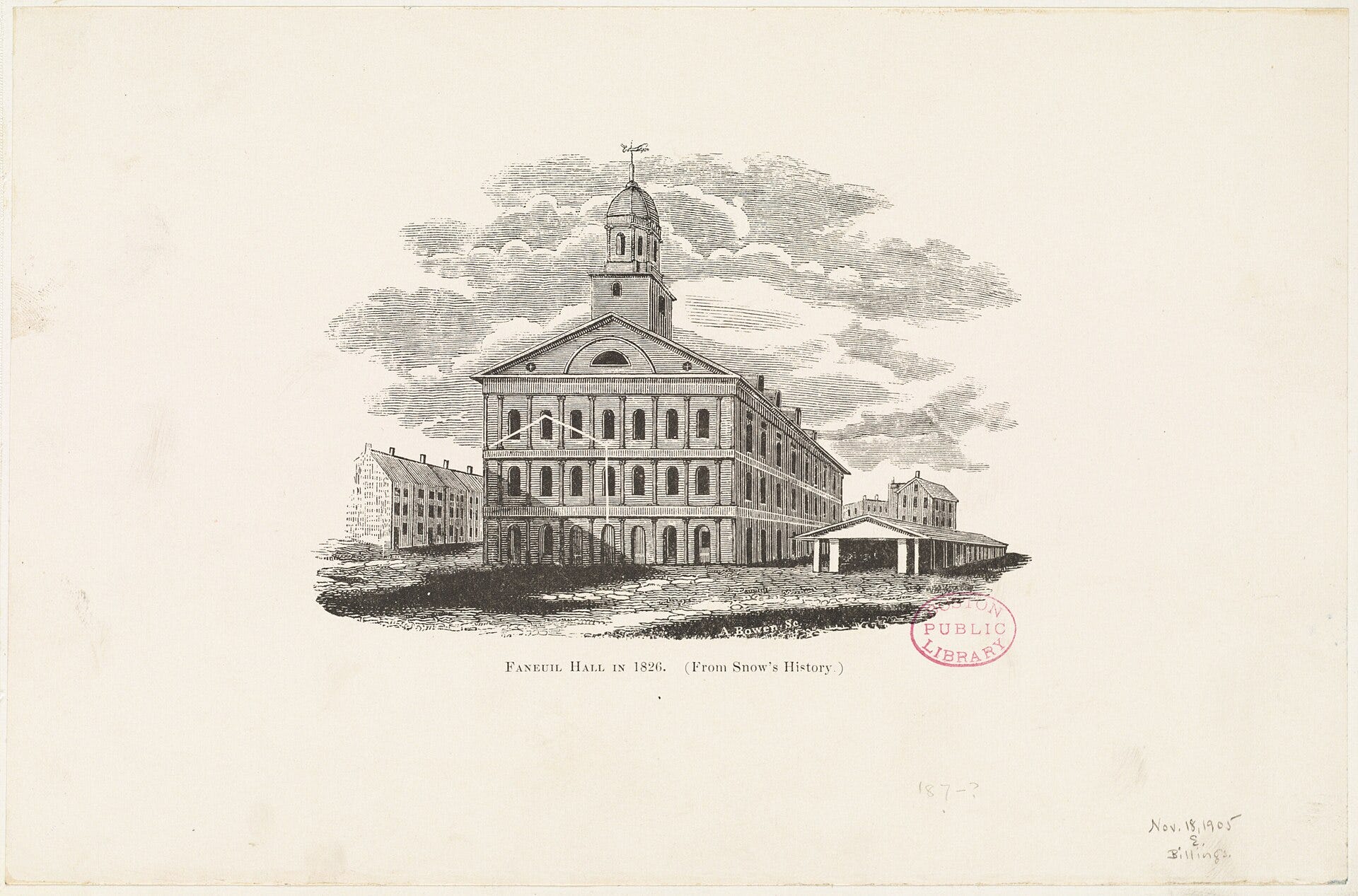
Faneuil Hall in 1826. Source: Wikimedia Commons
In Part I, Chapters 3, 4, and 5 of Democracy in America, Tocqueville moves from the social foundations of democracy to the local institutions that teach people how to govern themselves.
Reminder: I am using multiple translations; my main reading is from the hardbound copy of the Mansfield translation. When I refer to page numbers it’s to the Mansfield translation, and when I want to pull quotes that are longer I’ll use the online Schleifer translation, so the text may not match exactly but they are close (and I also read French so I calibrated across the translations to get comfy with Tocqueville’s word choice).
In the previous installment of this series, I examined Tocqueville’s account of America’s “point of departure” — his argument that nations, like individuals, bear the marks of their origins. Chapters 3, 4, and 5 now move from origins to structure. Tocqueville begins with what he calls the American “social state”, proceeds to the principle of popular sovereignty, and then descends into the detailed workings of towns, counties, and state governments.
He does not begin with the Constitution, the presidency, or the Supreme Court. He asks what kind of society Americans inhabit, where political power is understood to originate, and how ordinary people encounter that power in their daily lives. His answer is institutional as well as moral and developmental. Free government depends on more than distributing authority correctly on an organizational chart; it depends on forming people who know how to use liberty, and the town is where that formation begins.
The Social State and Its Warning
Chapter 3 opens with one of Tocqueville’s most important claims: “The social state of the Americans is eminently democratic” (p. 46). He never offers a tidy definition of “social state”, expecting readers to infer it from context. The concept describes the underlying pattern of relationships within a society — property distribution, status, inherited privilege, and social mobility. A political regime tells us who formally governs; a social state tells us how people stand in relation to one another.
America’s social state is democratic because it is characterized above all by relative equality of conditions — not equal wealth or talent, but the absence of durable, legally entrenched hierarchy. Wealth exists, but it does not create permanent castes. Social positions remain fluid; families rise and fall.
Tocqueville’s treatment of inheritance law makes the institutional logic precise. Under primogeniture, landed property remains concentrated and attached to a family line. Under partible inheritance, property divides among heirs at each death, producing what Tocqueville calls “a revolution in property” (p. 47): “Not only do goods change masters, but they change, so to speak, nature; they are constantly fragmented into smaller portions” (p. 47). A civil rule governing estates quietly reshapes the distribution of political power across generations. The democratic social state is neither simply natural nor simply designed — it is an emergent order whose development is powerfully shaped by legal rules, even as those rules themselves reflect underlying social conditions.
But equality of conditions does not guarantee liberty. A society of relatively equal individuals may move toward genuine self-government, or it may submit to a centralized and absolute power. Individuals freed from aristocratic superiors may govern themselves, or they may find themselves equally subordinate to a distant state. The corrupted democratic passion does not raise the weak; it seeks to pull down anyone appearing stronger or more independent. In its worst form, it leads people to prefer equality in servitude to inequality in liberty. America had avoided that outcome, Tocqueville thought, because its equality was joined from the beginning to favorable mores, enlightenment, religion, and, above all, local institutions capable of channeling democratic energy toward self-governance rather than submission.
Popular Sovereignty as Practice
Chapter 4 examines the political principle corresponding to the democratic social state. Tocqueville describes popular sovereignty in America not as a constitutional phrase but as a “law of laws” — a belief recognized by mores, proclaimed by laws, spreading freely without obstacle (p. 54).
The principle begins with individual sovereignty. Under the democratic dogma, each person forms an equal portion of the sovereign power, presumed as capable of self-government as any fellow citizen, obeying no one on grounds of natural superiority. Why, then, does anyone obey at all? Tocqueville’s answer cuts to the core of democratic political obligation (p. 61):
He obeys society, not at all because he is inferior to those who direct it, or less capable than another man of governing himself; he obeys society because union with his fellows seems useful to him and because he knows that this union cannot exist without a regulatory power.
Obedience rests on the recognized usefulness of association, not on natural hierarchy.
Despite being mutually reinforcing, individual sovereignty and popular sovereignty stand in potential tension. The same democratic principle that rejects rule by a natural superior can, when aggregated, produce rule by an overwhelming majority. The equal moral standing of individuals gives rise to collective power, and that collective power may bear on those same individuals with considerable force. Tocqueville does not pursue this problem fully here — his analysis of majority tyranny comes later — but its foundations are already visible, embedded in the very logic of popular self-rule.
The American Revolution did not create this principle from an abstract theory. It generalized and elevated what local communities had long practiced, sovereignty developing through lived experience before receiving a more universal political expression. This sequence is important for understanding how institutions actually form and sustain themselves — a theme running through all three chapters, and one that helps explain why Tocqueville turns immediately from popular sovereignty to the town. The town is the arena where the sovereignty principle becomes practice, where individual sovereignty and collective self-rule find their most immediate, tangible, and educative expression.
The Town as a School of Liberty
Chapter 5 is the longest and most institutionally rich of the three chapters. Tocqueville explains why understanding American democracy requires studying towns and states before the federal Union: the states created the federal government, not the reverse, and most important American political institutions developed first at the local level.
Tocqueville begins with an arresting observation: “The town is the only association that is so much a part of nature that wherever men are gathered together, a town takes shape by itself” (p. 57). But he immediately distinguishes the natural existence of towns from the political achievement of town liberty: “If the town has existed ever since there have been men, town liberty is something rare and fragile” (p. 57). Central authorities tend to encroach on local independence, while local institutions often lack the strength to resist. Town liberty survives only when legal protection has existed long enough to become embedded in mores.
Mores, on this account (and as discussed last week), are not doctrines imposed from above. They emerge through repeated interaction — citizens participating in local government, learning its procedures, developing expectations about appropriate conduct, and acquiring attachments to institutions through which they act. The formal institution gradually becomes a social habit, sustained not by compulsion but by familiarity and investment. And sometimes that goes the other way, with social habits that are robustly beneficial being codified as formal institutions.
Tocqueville’s deepest claim about town institutions is not that they produce efficient administration. It is that they educate citizens: “Without town institutions, a nation can pretend to have a free government, but it does not possess the spirit of liberty” (p. 58; note here that Schleifer uses “liberty” while Mansfield uses “freedom”).
Town government puts liberty within the reach of ordinary people, giving citizens manageable responsibilities and repeated opportunities to exercise judgment. They debate practical questions, raise revenue, select officials, oversee schools, repair roads, resolve disputes, and cooperate with neighbors whose opinions they may not share. In doing so, they acquire civic competence — learning that public problems do not solve themselves, that collective action requires patience and compromise, and that the neighbor with the most emphatic opinion is not always the person best equipped to repair the bridge. Liberty becomes habitual by being exercised.
Scattering Power
One of Tocqueville’s most striking observations is that New England town government deliberately “scatters” power (p. 64):
See with what art they have taken care in the American township, if I can express myself so, to scatter power in order to interest more people in public things.
Power is divided both to prevent abuse and to widen participation. By distributing offices and responsibilities among many citizens, the town draws more people into public life — numerous officials with specific duties creating numerous points of entry into governance, making public authority less imposing and more accessible.
This arrangement also does something subtle with ambition. At the national level, only a tiny number of people exercise meaningful power. Town government brings esteem, influence, and responsibility into ordinary life, concentrating the desire for recognition near the domestic hearth and redirecting passions that might otherwise become socially disruptive toward local public action. Tocqueville is not trying to eliminate ambition; he is institutionalizing it, connecting ordinary motives to socially useful activity.
Scattering power thus performs at least three functions simultaneously: limiting domination by preventing authority from concentrating in a single visible official (the constitutional function); mobilizing dispersed knowledge by giving those closest to local problems the capacity to address them (the epistemic function); and forming citizens by involving many people in public responsibilities (the civic function).
Tocqueville’s formulation of the objective is superb (p. 67):
In this way they wanted to make authority great and the official small, so that society might continue to be well regulated and remain free.
This institutional vision differs subtly but importantly from Montesquieu’s and Madison’s separation of legislative, executive, and judicial powers. Tocqueville is examining the vertical and horizontal dispersion of administrative responsibility throughout society — a nation may contain internally separated branches while still centralizing the administration of local life, leaving citizens as recipients rather than participants.
He distinguishes two forms of centralization. Governmental centralization concerns interests common to the whole nation: general laws, foreign affairs, national defense. Administrative centralization concerns the detailed execution of public affairs within particular localities. Americans had “almost entirely isolated administration from government,” maintaining capable central authority on genuinely national matters while leaving most administration to states, counties, towns, and citizens themselves (p. 85).
He concedes the costs: local administration may be uneven, amateurish, or duplicative. A centralized administration may perform certain tasks more neatly — files standardized, procedures uniform, reports arriving in triplicate, everyone enjoying the modest consolation of knowing that nothing can happen until Form 17-B has been approved in the capital. Yet administrative efficiency is not the highest political value. A system that solves public problems for citizens may gradually deprive them of the habit of solving problems together, the central administration growing more capable as the population grows less so. This dynamic becomes self-reinforcing. “What I admire most in America,” Tocqueville concludes, “are not the administrative effects of decentralization, but its political effects” (p. 90).
Tocqueville’s America and Ours
The America Tocqueville describes in 1831 feels simultaneously familiar and remote. The vocabulary persists — federalism, local control, divided powers — but the political structure has shifted, dramatically. National politics increasingly organizes political identity, even when the decisions affecting daily life remain local.
His description of ambition is especially revealing. In 1831, most politically ambitious citizens directed their energies toward towns and states, where they could exercise visible responsibility. Contemporary politics has largely reversed this orientation — national office dominating attention, fundraising, and partisan identity, while even local disputes are rapidly translated into national ideological conflicts. When political attention migrates upward, citizens may begin to regard meaningful power as something exercised elsewhere, local participation seeming small or technical by comparison. Yet national politics offers most citizens little opportunity to do anything beyond voting, donating, and becoming angry at professionally selected intervals.
Tocqueville would likely ask what this structure does to civic agency, whether it forms citizens capable of governing or spectators skilled at expressing approval and contempt.
These questions do not imply that America should recreate the Massachusetts town of 1831, even if it could. Many problems genuinely cross local and state boundaries, requiring coordination at larger scales. Tocqueville’s principle is not that everything should be local. His principle is that the burden of proof should fall on removing responsibility from those with the closest interest and knowledge.
Freedom, in Chapters 3–5, does not follow automatically from equality, nor from elections. It must be institutionalized, requiring legal protection, dispersed authority, repeated participation, and enough time for institutional practice to become part of the mores. The sovereignty of the people can remain a majestic abstraction, proclaimed in constitutions and invoked in speeches. Or it can become part of ordinary everyday life, exercised imperfectly by citizens deciding together what to do about schools, roads, public order, and the repair of the town hall.
The former may produce the appearance of free government. The latter produces its spirit.
Previous articles in this series:


Lynne, this may be my favorite essay in the series so far.
One thought that kept occurring to me while reading is that Tocqueville's argument depends on local institutions repeatedly teaching people how to exercise liberty until those habits become mores.
What I wonder is how that process changes when many of the institutions shaping people's assumptions are no longer local. Increasingly, people spend time in digital communities, professional networks, online niches, and social spaces that develop their own norms, status structures, and expectations.
In some ways these spaces seem to perform a similar formative function. They teach habits, values, and ways of interpreting the world. But they are not geographically rooted in the way Tocqueville's towns were.
I find myself wondering whether we are not only living through technological change, but also through a shift in where and how democratic mores are formed. How would Tocqueville describe this?
What is most evident to me in this essay is that Tocqueville read and understood Adam Smith's TMS.